A tiny story can start with one picture.
What happened first? What happened next? How did it end? Pick a familiar little moment—a trip to the park, making a pretend picnic or building a toy train—and give it three big pictures. A grown-up can draw while your child points, gestures, makes a sound or tells you what belongs on the page.
This Bouncer play idea works without a screen, a printer or special toys. Use a large sheet of paper and age-appropriate drawing materials, with a grown-up nearby. Keep the pictures on one page so there are no small loose pieces to manage.
Make your three-picture story strip.
| Story space | Try saying | Let your child choose |
|---|---|---|
| First | “Where does our little story begin?” | A place, a character, a point or a sound |
| Next | “Something happens. What could it be?” | An action to draw, show or act out |
| Last | “How shall we finish our story today?” | An ending—or a favorite moment to repeat |
These are invitations, not quiz questions. If your child wants to stay with the first picture, that can be the whole game.
For a younger storyteller, share just one moment.
For ages2–3, draw one simple action and describe what your child notices. You might say, “The train is going,” then leave a little space for a gesture or a choo-choo. Add another picture only if your child wants it. Their home language, a pointed finger or a sound is a way to join in; there is no need to ask for three complete sentences.
For an older storyteller, become Bouncer's story helper.
For ages4–6, invite your child to tell the story while you move a finger from the first picture to the next. Ask whether they want you to write their own words underneath. Read those words back without replacing them with an adult version. Try swapping the last picture for a silly new ending, or let your child act out the three moments while you describe what they do.
If the order changes, follow the new story. This is shared play, not a test. The age suggestions are flexible, and your family can stop whenever the activity stops being fun.
Watch a little adventure, then tell your own.
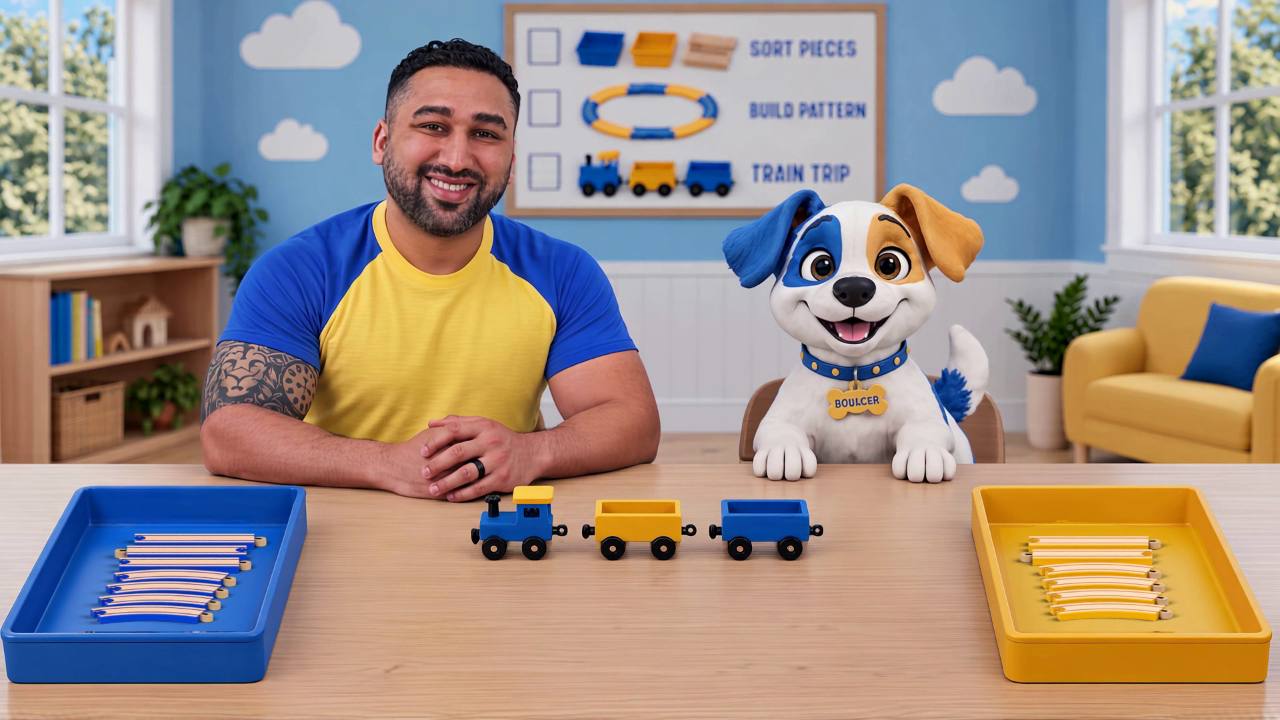
In The Train That Kept Trying, Edmund and Bouncer build a toy train, sort blue and yellow track pieces and keep trying together. A grown-up can choose the full episode on YouTube, then invite a picture of a favorite moment. Your home story does not need to reproduce the episode or get every detail right.
Prefer crayons and pretend animals? Choose The Coloring Book Jungle, then make your own three-picture adventure. Full episodes open on YouTube, which has its own privacy practices. Viewing is optional, and there is nothing to upload or sign up for here.
Finish with a story—and a high paw if you like.
Keep the drawing at home for another telling. Bouncer's next little adventure might begin with the same first picture and a completely different ending. Explore more play ideas or choose the next story together with your grown-up.
Until next time. Take it EZ. Bye, friends.
Choose a story together—or keep drawing.
Ideas behind the play
This original family-play invitation draws on caregiver-supported storytelling and retelling ideas. It is optional shared play, with flexible age suggestions and no learning outcome promised.