Begin with a pattern you can hear
Choose two quiet, comfortable actions, such as a gentle clap and a tap on your own knee. Do them in order twice while saying their names. Then invite your child to copy you. Keep the speed easy and the volume comfortable. Movement is optional: you can point to two drawings instead, or say “woof, hello” in two friendly voices. The pattern is the repeated order, not a performance to get exactly right.
Leave a little space for a turn
Repeat the first action and pause before the second. Ask “What comes next?” Give your child room to answer with an action, a point or a word. If they choose something different, try it and listen to the new sequence together. You can return to the original slowly: “Our first idea was clap, tap.” After a few rounds, let your child be the leader while you do the copying.
Ages 2–3: copy a small pair
Model the two actions side by side with your child. Two rounds are plenty to begin. You might clap together, then both rest your hands on your knees. There is no need to leave a gap or ask a question every time. Enjoy repeating the pair and naming what you are doing. If your child prefers one action, repeat that favorite and save the two-part idea for another time.
Ages 4–6: fix a silly pattern
Put four large paper marks in a row: circle, triangle, circle, triangle. Let your child continue with a drawing or a finger point. Then deliberately draw a different shape in the next space and wonder whether it fits the rule. Invite them to explain their idea. For another challenge, try two gentle claps and one tap as the repeating part. Say the whole unit together before adding the next one.
Make a pattern without buying anything
Lay out a big blue cloth, a yellow cloth, then another blue cloth. Ask which color could follow. Or draw a big puppy and a little puppy, then repeat the pair. For a screen-free ending, your child can invent a two-action goodbye, such as wave, smile, wave, smile.
Bring it back to the story
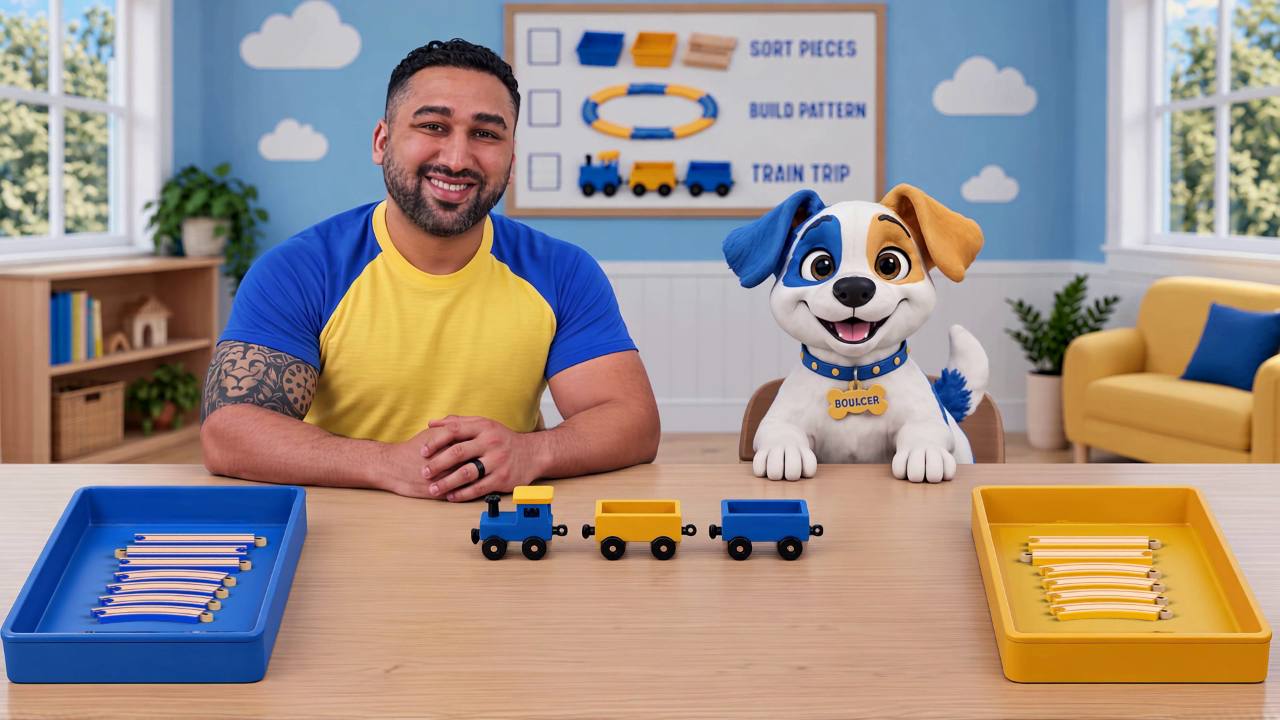
In The Train That Kept Trying, blue and yellow track pieces make a repeating color pattern. Watch the episode on YouTube with a grown-up and notice the order together. The existing train activity guide has a specific track-inspired play idea. This page adds sound and action variations, so choose whichever kind your child enjoys. Close with one favorite round rather than making the pattern longer and harder each time. Bouncer’s next adventure can wait for your next playful moment.
Grown-up questions
Does a pattern have to use colors?
No. Try a repeated pair of comfortable actions, quiet sounds, drawn shapes or large household objects.
What if my child invents a different next part?
Explore their sequence together. You can ask them to show their rule, then slowly model your original repeating pair again if useful.